04 May 2012

Adventures in Basketball's Bush League

(From RealClearSports)

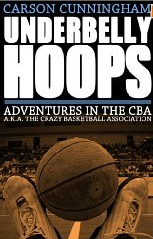
Once, on a road trip in 2004, beaten down from the CBA grind and (Coach) Dales’ ways, Trainer Brad told me, “I feel bad about waiting for the maid to go in and clean the room so I can grab soap from her cart and run. … [For CBA games, the home team is supposed to provide soap for both locker rooms, but apparently Dales didn’t like paying for that.] A few times I’ve just gone to Target and bought soap, just to appease Dales and let him think I’d stolen it from the hotel. I just took one for the team.” 

- Carson Cunningham, "Underbelly Hoops"


It doesn't get any more bush league than the ol' CBA. Ten-hour bus rides; staying at motels where the towels were so rough that you wouldn't even think of swiping them; and a diabolical coach who hid the fact your wife was hospitalized because he wanted you to finish practice.

Such is the life in the "underbelly."
Screen%20Shot%202012-05-03%20at%209.58.30%20AM.png
The Continental Basketball Association, the irrepressible, irredeemable basketball league might be gone, but some of its memories are forever preserved for posterity in Carson Cunningham's irreverent and humor-laced "Underbelly Hoops: Adventures in the CBA."

You might remember Carson, a former All-Pac-10 freshman point guard at Oregon State who, after transferring to Purdue, nearly led the Boilermakers to their first ever Final Four under Gene Keady. He spent four years chasing the dream of reaching basketball's holy grail, the NBA, before finally hanging up his sneakers and settling into his new life as Dr. Cunningham, teaching history at DePaul University.

But the "Underbelly" is about more than just chasing a dream. It's also a love story.

"A lot of us do it for the pure love for hoops," Cunningham says during an interview with RealClearSports. "We keep grinding away because we want to play high-level hoops. It was good basketball (in the CBA). From top to bottom, the league was better than any major (college) conferences. The basketball was good, underrated. There were a lot of super-talented players and I didn't appreciate how good the players were until I was in the league.”

One of those was Keith "Boss" Closs, a 7-foot-3 center who was at one time a rising star with the Clippers but the big-hearted shot blocker with a big vice somehow ended up playing for Cunnigham's Rockford Lightning. During a late-December road trip to Flint, Mich., Closs apparently passed out at a nightclub after the game and was dumped at the local police station by players from the opposing team. The next morning, the gregarious Closs sat under the Christmas tree regaling a group of curious cops about his life and times in the NBA as if he were an oversized Santa Claus, before an assistant coach was sent to fetch him.

It took a thick skin, and a somewhat irrational personality to survive in the CBA. You didn't do it for the pay, that's for sure, since most guys earned hundreds of dollars per week, plus occasional McDonald’s coupons that passed for per diem. It wasn't for the glamour and the amenities - when you consider a Red Roof Inn was a treat and at some games the crowd count was short of triple digits.

While Cunningham might be a hoops junkie chasing every Hoosier’s boyhood dream, he was a man with a plan. During his stints in the CBA, he was also working on his Ph.D. in history at Purdue. As his teammates spent countless hours pounding away at video game consoles, he read, wrote and kept a diary of his existence in the underbelly.

“It’s living on the fly, you just basically learn to adapt to uncertainty, and roll with it,” Cunningham says. “When you’re in your early 20s, you have a lot of energy and you have a lot of down time to get some stuff done. I’ve always enjoyed the process of writing and I liked it that during my minor league days I was able to combine two passions.”

Cunningham adds that the CBA was able to get the hoops out of his system so that when the time came, he was ready to move on with his career, get married and have kids. His book isn’t so much a tell-all about his ex-teammates and coaches, but a memoir, and maybe even a cautionary tale about the nomadic minor-league existence.

Two recent stories neatly presented the juxtaposition of this phenomenon. Jeremy Lin, who spent a bulk of his professional career riding the bench in the NBA and playing in the D-League, broke out and became an instant star. Meanwhile, Antoine Walker, who made over $100 million in his NBA career, was plain broke and last seen playing for the D-League team in Boise.

“One thing I struggled with in the book is how to cope with riding the animal – so to speak,” Cunningham says. “Jeremy Lin epitomizes (the dream) for thousands of hoopers like us. I think in a way it's inspiring but at the same time you have to confront the reality that your NBA dream might never come to fruition.

“There’s a fine line on chasing a dream and how hard to chase it. … I was grateful to have a backup plan, but I’ve seen a lot of unfortunate situations. I never had a lot of money but you would come across guys who made a chunk and ended up with nothing.”

The D-League, a wholly owned subsidiary of the NBA, is essentially an offspring of the CBA, which managed a half-century of existence that, wrote Cunningham, “survived the Cold War, economic recession, relative obscurity, and Vietnam, among other things. Over 53 years, nothing seemed capable of toppling it. But then, Isiah Thomas showed up.”

Through Thomas' mismanagement, the CBA began its death spiral, but not before providing refuge for hundreds of more hoop dreamers before its demise in 2009. Cunningham might have eventually found a cure for what he called an “affliction,” but he stuck around long enough to serve up a nice slice of Americana.

And even now, in his new life, Cunningham occasionally finds himself missing the wilderness of the underbelly:

Now, don’t get me wrong, I loved the way things were rolling with my wife and our little one, and I liked teaching history. … But I still couldn’t completely shake it. I still wanted a run. 

I started to really feel it after we went to a dinner party and this couple with a bunch of advanced degrees started in on the movie “Crash.” The lady, kind of affected-like, said “More than race, [it’s] about class.” I felt like puking. … She went on and on about how profound the movie was, but did so in a way that made me want to put on Tarzan gear and run out to the wild and beat a drum or swing from a tree – or go play in the CBA.

22 January 2012

The State of History in 2012

(From RealClearHistory)

Editor's note: In advance of President Obama's State of the Union address on Tuesday, RCP is rolling out daily "state of" reports to better frame the issues facing the nation. Today: The state of American history.

Over the Christmas holiday I took my family to Pearl Harbor, shortly after the 70th anniversary of the Japanese attack that plunged the United States into World War II. I figured that my daughter, now 6 and in first grade, should be old enough to get an up-close and personal experience with this key chapter in world history.

But I was soon consumed by a horrifying event.

While waiting for the boat to take us across the channel to the USS Arizona Memorial, I overheard a group of college students discussing history. Unable to help myself, I lingered to eavesdrop. And this is the gist of what I heard:

“The World War II [sic] started with a bunch of countries on one side and a bunch of countries on the other side,” a young man began, his companions listening with rapt attention as if it were a lecture, “and we didn’t know which side we wanted to be on and we had a hard time picking sides. But when the Japanese attacked us, that made it easy to go against their side.”

I didn’t know whether I should be enraged at or take pity on the young man’s ignorance. But what was most troubling was that he was the one dispensing “knowledge”! The others -- judging by the fact that no one disputed or challenged his account -- knew less than he did, even after apparently 12 years of compulsory education.

But suddenly I remembered that President Obama, born and raised in Hawaii, once mentioned that a single bomb had been dropped on Pearl Harbor (in the fashion of Hiroshima) ... then it all made sense.

We’re now a country led by a man who thought JFK talked Khrushchev out of the Cuban missile crisis (he didn’t); claimed that our country built the “Intercontinental Railroad” (must be from New York to Paris); and bragged that his uncle liberated Auschwitz (was he in the Soviet Red Army?).

And I’m not picking on just Obama. His political detractors are every bit as ignorant on history: Ask them about the American Revolution, and you’d find that Michele Bachmann thought the battles at Lexington and Concord were in New Hampshire; Rick Perry believed the war was fought in the 16th century; and Sarah Palin claimed it all began when Paul Revere warned the British.

It’s symptomatic of our times. The people who aspire to hold the highest office of our land actually know very little about the history of this nation, let alone the rest of the world.

If anything, this is a terrible indictment of our education system, from elementary schools to the institutions of higher learning, including even the most elite universities (after all, Obama attended Columbia and Harvard). It’s possible now to have 16-to-20 years’ worth of education and not come away with even a cursory grasp of history that actually matters.

But if you’re in California, where I live, your kids will get a healthy dose of history about Native Americans, African-Americans, Mexican-Americans, Asian-Americans, and soon, gay, lesbian, bisexual and transgender Americans, as mandated by state law. By the time they’re ready for college, they’ll know far more about Cesar Chavez, Huey Newton and Harvey Milk than George Washington and Abraham Lincoln.

While there’s nothing wrong with learning a particular subset of history, doing so should not come before or at the expense of the core fundamentals, which are now badly neglected or perverted by political correctness. You shouldn’t try to learn about climate change if you don’t know what makes it rain.

A Marist College survey last year revealed just how clueless Americans are about history. Barely half of the respondents knew that the U.S. declared its independence in 1776 (Rick Perry sure wasn’t among them), and over a quarter thought the colonies revolted against a country other than Britain (some believed it was China). The percentage of correct answers was proportional to the respondents’ age -- which certainly is no surprise.

As our generations get more ignorant about history, it prompts the question: Does history still matter?

I hesitate to bring up George Santayana’s famous “those who cannot remember the past are condemned to repeat it” warning, because “remember” implied that it was learned at one time and later forgotten. In these times, it’s rather more like “those who are ignorant of the past are destined to screw up because they think they’re doing something new.”

If you never learned a lick about the Habsburgs and the Thirty Years’ War and the Anschluss, then it would make sense to think folks in Austria speak “Austrian.” If you knew Churchill only as a caricature colonial master oppressor, of course it’d be easy to pack up his bust and send it back to the Queen. And if you believed Kennedy talked Khrushchev out of putting nuclear missiles in Cuba, then why wouldn’t you want to sit down and chat with Mahmoud Ahmadinejad?

Sadly, things won’t be improving much even in an age of hyper-connectivity, where everything is at our fingertips. Teenagers are spending far more time Googling Lady Gaga than Lady Thatcher. Don’t look to the big screen for help, either. The recent biopics on the Iron Lady and the Tuskegee Airmen (“Red Tails”) are following the fine Hollywood tradition of “JFK” and “Pearl Harbor” -- at best, distortions and at worst, garbage.

So when it comes to the future of history ... you’re on your own. But thanks to that hyper-connectivity, there are ever more historical accounts and documents available to you, painstakingly written and prepared by lots of knowledgeable and dedicated people. The challenge, of course, is to sift through all that information.

That’s where we come in with our humble pitch: We launched RealClearHistory in September 2011 with the mission of delivering daily authoritative and informative history commentary and analysis.
There are also, of course, a number of established great sites, including the University of Houston’s Digital History, George Mason’s History News Network and The History Channel, just to name a few.

Of the many reasons why it’s important to develop a well-rounded understanding of history, we’ll mention just one in closing: To honor the sacrifices made in the past. In the case of Pearl Harbor, it’s so the sailors and Marines who gave their lives on Dec. 7, 1941, didn’t die in vain.

20 January 2012

The State of American Sports in 2012

(From RealClearSports)

Editor's note: In advance of President Obama's State of the Union address next week, RCP is rolling out daily "state of" reports to better frame the issues facing the nation. Today: The state of American sports.

On so many levels, most sports fans are happy to see 2011 in the rearview mirror. Both the NFL and NBA had prolonged work stoppages that threatened their seasons. Two major college programs - Ohio State and Miami - were exposed for rampant cheating involving criminal elements. And on top of all that, the alleged child rape scandal at Penn State not only obliterated its football coaching staff, but shook the entire university to its core.

So 2012 should be a stroll in the park then, with a restoration of the usual fun and games, right? While things can’t possibly be as bleak as they were last year, there are some dark clouds looming. Here’s a look ahead:

PROFESSIONAL SPORTS

The NFL resolved its labor crisis with no loss of regular season games, and its perch as king of American sports was not threatened by the lockout - in fact, it might have become more entrenched. The $9 billion industry now is guaranteed labor peace for the next decade, and has further stuffed its coffers with a nine-year TV contract extension, worth $3 billion per year. Interest in the league is at an all-time high, buoyed in recent weeks by Tebow-mania, which just adds an embarrassment of riches to a league that hardly needs more publicity.

So the rest of the sports leagues will have to fight for the NFL’s leftover scraps. Major League Baseball managed to secure its own long-term labor peace without any rancor, though performance-enhancing drugs continue to cast a shadow on the sport, both in terms of Hall of Fame enshrinement of alleged PED users and the recent revelation that NL MVP Ryan Braun had failed a drug test.

The NBA had its own labor dispute, with the season saved by a last-minute deal that still came with a cost: the loss of about 20 percent of the games. But the sport with trouble ahead is the NHL, which already had one entire season wiped out in 2004-05. Donald Fehr, who spearheaded several of baseball’s labor wars, is now the head of the NHL players’ union. He had fired a shot across the owners’ bow last week by rejecting a realignment proposal, setting the stage for turbulent times ahead as the current deal is scheduled to expire in September.

COLLEGE SPORTS

NCAA President Mark Emmert might just have the most thankless task in sports. He has to navigate a billion-dollar industry masked as amateur athletics. The scandals at Ohio State and Miami (among others) demonstrated that the difficulties of maintaining a flawed system whose entire labor force is undercompensated 18-to-22-year-olds who can easily fall prey to nebulous outside influences.

A new proposal is on the table to pay compensation to college athletes in the form of a $2,000-per-month stipend. But that’s akin to patching up a gunshot wound with a Band-Aid. Emmert is considering more sweeping reforms that may more adequately address systemic issues facing the NCAA, which still operates an antiquated model that is no longer compatible - economically or otherwise - with the times.
(From RealClearSports)

College football, the real cash cow in college athletics, has specific problems to address that fall outside of the purview of the NCAA. The Bowl Championship Series (BCS) is universally derided, with criticism only intensifying after the most recent championship game that pitted two schools (Alabama and LSU) from the same conference. The BCS also has done its part to destroy century-long rivalries by ushering in a conference realignment frenzy. With its current TV deal scheduled to expire after the 2013 season, the BCS will be forced to contemplate a dramatic shakeup, likely as soon as this summer.

THE OLYMPICS

If it’s a leap year, it must be time for the Summer Olympics. The 2012 London Games are facing numerous challenges, not the least of which is measuring up to its predecessor. The 2008 Games were orchestrated nearly flawlessly by China’s communist government, which spared no expenses or manpower to make sure everything went smoothly in Beijing, including an event-best 51 gold medals for the Chinese.

The U.S. team finished a distant second with 36 golds, though it did garner a Games-high 110 total medals. The Americans are favored to top both standings this year in England, with high hopes for a number of athletes, particularly swimmer Michael Phelps, who is expected to add to his record 14 gold medals in his final Olympics.

SPORTS MEDIA

For the first time since 1988, the Olympics broadcast will not have Dick Ebersol at the helm, and that’s a good thing, as his insistence on tape-delaying live events had caused a steady decline of TV ratings on NBC, for both Summer and Winter Games.

NBC’s new owner Comcast will instead use the Olympics to increase viewership and visibility for its family of networks - especially the NBC Sports Network (formerly Versus) - and Web properties by making nearly every event available live, either on TV or via live-streaming.

NBC, as well as Fox and CBS, are trying to maintain their influence in a sports media landscape increasingly dominated by ESPN, which raked in $8.5 billion in revenue in 2010 for parent company Disney. ESPN has been able to dramatically increase its cash flow by extracting ever more subscriber fees from cable and satellite operators to supplement its advertising revenue.

As a result, bidding wars for sports programming have caused rights fees to skyrocket. In just the last year, NBC paid $4.3 billion to the International Olympic Committee (for four Olympics through 2020); Fox, CBS and NBC paid $28 billion to the NFL while ESPN paid $15.2 billion for its own separate “Monday Night Football” deal (through 2022); ESPN also paid $500 million to the NCAA for non-football and non-basketball championships (through 2024); and CBS and NBC paid an undisclosed amount to the PGA Tour (through 2021).

All that cost of doing business will eventually be passed on to the average sports fan, even if he or she decides to forego paying escalating ticket prices and instead watches everything from home.

But the good news is that - other than, potentially, the NHL - there will be plenty to watch in 2012. And if we’re lucky, we won’t have to deal with learning a new household name, as we did in 2011 with Jerry Sandusky.

16 January 2012

The State of the World in 2012

(From RealClearWorld)

By Samuel Chi, Kevin Sullivan and Greg Scoblete

In advance of President Obama's State of the Union address next week, RCP is rolling out daily "state of" reports to better frame the issues Obama will likely address.

As the United States heads into a crucial presidential election in November, it must keep a wary eye beyond its borders. Will there be a conflagration - of either an economic or military kind - that might consume the world?

China, the United States’ chief rival as a superpower in the coming decades, is also facing a potential leadership change this year. Though the U.S. has pulled out of Iraq, embers of conflict continue to burn brightly in Afghanistan and Pakistan. And the Middle East, with Iran’s unceasing bellicose posturing and the Arab Spring’s unsettled affairs, will continue to be a flashpoint.

But the world might be plunged into more disorder by not just guns and missiles. The Eurozone crisis could cause the disintegration of the common currency - if not the European dream itself - before infecting the rest of the global economy.

With so much troubling news abounding, we now offer a sweeping look at looms ahead in 2012:

CHINA

There is one bit of genuine good news: Incumbent Ma Ying-jeou just won re-election as Taiwan’s president, thus likely ensuring peace and stability in the Strait for the next few years. It was an election that was nervously observed in both the U.S. and China, and its result was greeted with a collective sigh of relief.

But later this year the People’s Republic of China will have its own leadership contest, with Xi Jinping widely expected to succeed Hu Jintao as the nation’s next president. While not a great deal is known about Xi, there’s genuine concern that the leadership of the People’s Liberation Army has been gaining clout within the political apparatus of the ruling Communist Party. Xi’s ability to handle the PLA would have a profound impact on how China deals with its neighbors in the coming years.

As an emerging superpower, China also has growing troubles and responsibilities. While its economy is expected to pass that of the U.S. this decade, there are systemic pressures that may cause it to unravel. For one, there is mounting unrest among the nation’s poor and in the minority-inhabited hinterlands.
And North Korea, with its own recent leadership change, will continue to test China’s diplomatic acumen.

IRAN & SYRIA

Looming large over a Middle East in flux is the Islamic Republic of Iran and its controversial nuclear enrichment program. As sanctions begin to take a greater toll on the country, many believe the regime will look, in desperation, toward provocative maneuvers -- such as closing the vital Strait of Hormuz -- to disrupt regional stability and inflate global oil prices.

Last week’s assassination of yet another Iranian nuclear scientist appeared to be just the latest strike in a growing cold war between Tehran and the West over the Islamic Republic’s nuclear ambitions. Iranian influence through proxy organizations in Lebanon and the Palestinian territories, in addition to a friendlier government in Baghdad, only make the potential consequences of a preemptive strike against Iran that much worse.

However, while the threat of war in Iran weighs heavy on the Mideast, Tehran’s allies in Damascus may in fact be the next domino to fall. As confrontations between loyalists to Syrian dictator Bashar al-Assad and army defectors increase, other Arab powers are beginning to fear a full-blown civil war in the Levant.

WAR IN AF-PAK

The U.S. war in Afghanistan is now in its 11th year in 2012 with an outcome that remains hazy and uncertain. For its part, the Obama administration has quietly but unmistakably engaged the Taliban in the hopes of finding a negotiated settlement. The Taliban now has offices in Qatar where officials claim they will attempt to "reach an understanding with the international community." The chances the two sides will find common ground remain remote, as previous negotiations have collapsed.

Support for the war in allied capitals is likewise collapsing. As the U.S. enters its election season and as Europe enters into a prolonged period of budgetary austerity, sustaining a large-scale deployment and aid mission in Afghanistan is proving to be a difficult sell. As the Center for Strategic and International Studies' Anthony Cordesman has observed, neither President Obama nor his GOP challengers have bothered to address the Afghan war even though monumental decisions about the long-term U.S. footprint are looming.

Meanwhile, U.S. relations with Pakistan have reached a post-9/11 low at a moment when Pakistan is reeling from another domestic political crisis. The so-called "Memogate" controversy is splitting Pakistan's political elite along familiar civilian/military lines and risks triggering further domestic instability at a time when U.S. leverage in the country is at its lowest ebb.

MIDDLE EAST & THE GREATER ARAB WORLD

At this time in 2011, the Arab world was just embarking on what would prove to be a year of revolution and reform that has altered the face of the region. Few knew that the self-immolation of a fruit vendor in Tunisia would quickly grow into widespread unrest and leap-frog from country to country, empowering frustrated Arabs and resulting in the end of once impervious monarchies and dictatorships. Regional stalwarts such as Egyptian President Hosni Mubarak and Libyan leader Moammar Gaddafi are now, respectively, either deposed or dead, and for perhaps the first time in history, Arabs appear ready to empower, rather than oppress, their own people.

But though the status quo has been upended, many questions remain for the region. In the absence of secular dictators and despots there is now the powerful electoral force of political Islam. Whether these movements -- which often push for stringent social regulations and Koranic interpretations of the law -- foreshadow an era of liberal democracy or religious theocracy is still unclear.

Such geopolitical shifts and uncertainty have left Western powers, not least of all the United States, in a rather precarious spot. The old formula of buying off despots for regional stability and easy access to energy resources, while still prevalent, might not remain viable in the years to come. Early indicators suggest that the U.S. is adapting to the new realities on the ground, as just last week it was reported that “high-level” meetings between the State Department and Egypt’s Muslim Brotherhood have been ongoing. Similarly, in the Sunni monarchy of Bahrain, a once routine U.S. arms sale has been put on hold due to concerns over human rights violations against the kingdom’s disgruntled Shia majority.

GLOBAL ECONOMY

Perhaps Christine Lagarde, head of the International Monetary Fund, had the pithiest summation of the state of the global economy on the eve of the new year: "quite gloomy."

That is, if anything, an understatement. Lagarde herself has warned of the dangers of a second Great Depression if coordinated action was not taken to stem the sovereign debt crisis in the Eurozone. In 2011, Eurozone leaders managed to avoid key existential questions surrounding the future of the Euro currency -- whether the Eurozone would be a true union that would involve cash transfers from the rich core to the profligate periphery or whether nations like Greece should break off from (or be kicked out of) the group. They would undoubtedly like to delay such a fateful call, but the bond market is already signaling its displeasure. The European project may be facing its reckoning in 2012.

The state of affairs looks brighter across the Atlantic, as the U.S. enters a new year with economic indicators generally positive. Yet America's economic fortunes are bound up in a global economy, and beyond the Eurozone, China's own blistering economy is showing signs of cooling off. Analysts have begun raising the alarm about a potential "hard landing" for the Chinese economy, but even a soft one, coupled with a recession in the Eurozone, could be sufficient to tip the U.S. back into its own recession. A gloomy prospect, indeed. 

CONCLUSION

Several key questions hang over the world in 2012. Will the Eurozone collapse? Will the Arab Spring yield a new and generally more stable and benign Middle East or something worse? Will the U.S. and NATO find a satisfying off-ramp in Afghanistan? Will Iran's nuclear program trigger an arms race, or worse? Will China avoid a political or economic crisis?

Most of these questions may not find a satisfactory answer in the year ahead, and there remains the ever-present possibility of "unknown unknowns" that could rear up to dominate the global discussion. In any event, the course ahead looks rocky and uncertain.

Buckle up.

20 May 2011

Could Lost NFL Season Cost Obama His Job?

(From RealClearPolitics)

Will Barack Obama take it upon himself to end the National Football League impasse?

For reasons both atmospheric and economic, he should at least think about it.

With Monday's ruling from the 8th U.S. Circuit Court of Appeals that keeps the owners' lockout intact, there is a possibility that both sides will dig in, thus putting the upcoming season in peril. More than two months into the lockout and just two months from the scheduled start of training camp, the NFL is already way behind in preparing for the upcoming season.

Any lost games -- even preseason ones -- have an economic cost to the teams and the cities they do business in. The NFL Players Association estimated that each NFL city stands to lose $160 million over the course of the season, or $16 million per home game. Though these figures may be greatly exaggerated (the most conservative estimate is at $35 million per city for the season), there is no doubt that millions of dollars and thousands of jobs will be lost should the games be canceled.

A number of NFL teams, the Miami Dolphins among them, have already drastically reduced their staff or cut pay during the lockout. Keep in mind that each team and its host city hire a large number of people, from full-time employees who work in custodial, food service and media relations at the training facilities, to contract workers who sell souvenirs, clean up and provide guest services at stadiums. Not to mention thousands of cops and firefighters who depend on overtime income from working on game days.

The economy and jobs. Now do they sound like something President Obama should worry about? Left unmanaged, the damage from a lost season may very well negatively affect his re-election chances in 2012.

In 2008, Obama won 365 electoral votes, comfortably beating John McCain for the presidency. But since the Democrats' 2010 midterm election wipeout, combined with the reallocation of electoral votes following the 2010 Census, his prospects have arguably worsened already. And that doesn't even take into account the bleak employment picture that has persistently dogged his presidency.

Six states, each home to at least one NFL franchise, may just hold the key to his bid for a second term.

These six (North Carolina, Indiana, Florida, Ohio, Virginia and Colorado) all went for George W. Bush in both 2000 and 2004, and they were also the states where Obama's winning margins were the smallest in 2008, ranging from 0.3 percent in North Carolina to 8.9 percent in Colorado.

Nine NFL teams reside in these six states (the Washington Redskins are headquartered in Ashburn, Va.). And if you take the NFLPA's estimates at face value, a whopping $1.44 billion worth of economic activity, not to mention tens of thousands of jobs, may be lost in these states from a canceled season.

If Obama should lose all six states (not a stretch, since neither John Kerry nor Al Gore carried any of them), his electoral vote total would plummet from a census-adjusted 359 to 264 -- the difference between winning the future and winning funds for a presidential library.

Moreover, even states the president won more comfortably in 2008 may be in play in 2012 after the GOP landslide of 2010. A total of 40 electoral votes could be up for grabs in Minnesota, Wisconsin and Pennsylvania -- home to the Vikings, Green Bay Packers, Pittsburgh Steelers and Philadelphia Eagles.

Given this landscape, should the current impasse persist, it may behoove Obama to pick up the phone and -- to paraphrase the 44th president himself when he spoke of college football's lack of a playoff -- "throw my weight around a little bit." Obama can call any number of people, and it's reasonable to surmise that he may have DeMaurice Smith's number on his BlackBerry.

It's not that the head of the NFLPA contributed to the Obama campaign (he did), it's that "De" Smith was elected to head the players' union last year on the strength of his legal and political connections. He was largely unknown by the players he sought to lead, but Smith is a former colleague of Obama confidant and U.S. Attorney General Eric Holder, and he's a former partner at Patton Boggs, a powerhouse law firm with an extensive lobbyist operation and strong ties to the Democratic Party. Three months ago, Patton Boggs adviser Frank Wisner was sent to Egypt as Obama's personal envoy to deal with Hosni Mubarak.

Professional sports are hardly on the same level as Middle East peace, but Obama can pick up the phone and lean on another Patton Boggs man to break the impasse in pro football. That isn't always enough, even for a president of the United States. Bill Clinton learned that lesson when he tried unsuccessfully to mediate the baseball strike of 1994-1995. But voters gave Clinton credit for trying.

If Obama does call and push him to make a deal, even the heretofore stubborn Smith will have incentives to comply. After his grand strategy of litigating instead of negotiating was shredded by the 8th Circuit, Smith doesn't have a lot of options left. Given his track record, it's doubtful that he'd be an NFL lifer, as his predecessor Gene Upshaw was. So his best course of action might be to cut a deal quickly, proclaim it was done in the interest of the fans, tell the players it was all worth it, before exiting gracefully.

Perhaps just in time to land a gig on Obama's reelection campaign.

21 January 2011

Joint Press Conference Double Speak

(From RealClearWorld)

rsz_hu_obama.jpg

Because of the disjointed setup with respective language translators, President Obama's joint press conference with Chinese President Hu Jintao was often interrupted for translations of remarks and questions into both English and Chinese. But it also allowed an opportunity for bilingual speakers to pick up nuances from the original remarks.

Hu, true to form, came well prepared, particularly with numbers and statistics, as befitting a former engineer. He handled all queries comfortably, even though as the head of a one-party dictatorship, he's never obliged to face a blistering free press at home.

On one occasion, Hu did flash noticeable annoyance, even a slight temper, when asked why congressional leaders are snubbing him at the state dinner tonight. He tersely concluded his remarks with "that's a question for him," and pointed to President Obama. It was a moment reminiscent of John McCain's contempt during a debate in the 2008 presidential election when he pointed to Obama and barked "that one."

Hu did not say "President Obama" as the English translator did, and he was not at all amused, even offended by such a snub. And at least partially he blamed Obama because he must have believed that Obama should have held sway to prevent an incident that would be viewed as a colossal "loss of face" for him at home.

Obama, on the other hand, kept his composure and handled the questions deftly, with skillful dancing on the inevitable and contentious issue of China's human rights record. His one light-hearted moment, though, was also lost in translation.

When asked of a potential challenge from Amb. Jon Huntsman for the presidency in 2012, Obama quipped that the fact that he and Huntsman (a former Republican governor of Utah) work so well together has to help Huntsman in the GOP primary. But the Chinese translator did not get the joke and spoke as if Obama meant it sincerely.

The technological problems have to be seen as somewhat of an embarrassment for the White House. With the leaders of the two most powerful countries meeting in a summit, the U.S. appeared ill-prepared for something as simple as a press conference. The quality of the translators (both for English and Mandarin) is also questionable, as both spoke with a slight accent.

Maybe it's time to boost the ranks of fluent Chinese speakers in the U.S. diplomatic corps. These summits with China's leaders will only increase in frequency for the foreseeable future.

17 December 2010

UConn Women Not Rivaling UCLA's Streak

(From RealClearSports)

The UConn women’s basketball team isn’t going to top UCLA’s 88-game winning streak.

The Huskies can beat Ohio State on Sunday, Florida State on Tuesday and then win their next 100 games for all I care, but John Wooden’s Bruins will still own the longest winning streak in history.

The longest winning streak in men’s basketball history, that is.

UConn will have the longest winning streak in women’s basketball. And before you get your PC undergarment all twisted up in a knot, let’s just make one thing clear: There isn’t such a thing as a record for all of college basketball. It’s either a men’s record or a women’s, and never the twain shall meet.

Comparing men’s and women’s basketball isn’t like apples and oranges. It’s more like apples and meat loaf.

Would you say Brett Favre’s 297-game consecutive starts streak is an all-time record for all oblong balls sports, obliterating every record from rugby to Australian Rules Football? Of course not, that would be silly.

So why would you insist on merging records of two sports that use different sizes of balls, different timing rules and different measurements within the courts?

Besides that, men’s and women’s basketball have no common lineage or connection; it’s not as if the sports at some point intermingle with each other. Every NBA player at some point of his life played boys' high school basketball, and most of them played men’s college basketball. Exactly zero has ever played girls' basketball or women’s basketball. (And the reverse is true as well: no WNBA player has ever played men’s basketball.)

This is not to diminish what Geno Auriemma and his Huskies have done, far from it. In fact, they should be celebrated for their prolonged excellence. Achieving a winning streak of this length is hard to do in any sport. They deserve every bit of adulation and admiration that are bestowed upon them.

And let’s not marginalize their accomplishment by disparaging their competition. Yes, it’s true that there are very few elite teams in women’s basketball, since most schools field women’s teams out of compliance for Title IX more than anything else. But the Huskies can only beat what’s on their schedule. It’s not their fault if their opponents are not typically up to snuff and tend to get rolled.

UConn’s women already own the women’s college basketball streak when they won their 71st consecutive game last March, against Notre Dame. Now they’re adding onto that streak, which should easily reach triple digits.

The fact that the UCLA streak is even in conversation is a disservice to the UConn women. It only draws unfair comparisons between two squads that are not even on the same planet. Fine, if these two teams played each other 88 times, Bill Walton’s Bruins would beat Maya Moore’s Huskies 88 times by at least 30 points each. But that is totally senseless so why even go there?

Why can’t we see what UConn is doing for its own sake? The Huskies are going for their third straight NCAA championship, eighth in the program’s history. Geno will get a chance to finally tie his archrival Pat Summitt for most titles of all-time – in women’s basketball. Those are the records they're chasing after, nothing more and nothing less.

Please leave the four-letter word out of it.